 Contact Us
About GoS
Now in its 28th year, and
Contact Us
About GoS
Now in its 28th year, andstill amateur & advert-free Please do not copy GoS
material without asking
Can you help? This page is the result of the best endeavours of all concerned. If you spot a mistake or know of facts to add, or have a better photo, please get in touch using 'Contact Us' (top, right).
Back to GoS-DB Hub Find Another Player
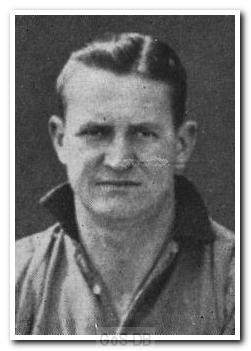
BILL STRAUSS
Full Name: William Henry Strauss
Born: 06 January 1916
Came from: Aberdeen Went to: Retired
First game: 31 August 1946 Last game: 16 September 1953
Appearances: 166 (166/0) Goals: 42
Born in Benoni, in the modern-day Gauteng region (formerly within the Transvaal province) of South Africa, Strauss moved to Britain in 1935 arriving on board the SS Arundel Castle.
Strauss was a dashing left-winger who was spotted by the Dons shortly after his arrival in Britain. He played a major part in the Dons' run to the 1936-37 Scottish FA Cup Final, but was injured in the semi-final, which meant he missed out on the big day, which saw a 2-1 defeat to Celtic in front of a record 144,000 at Hampden Park. It was a popular belief that if Strauss was in the Final line up the Dons would have won. During the War, Strauss reached the rank of Lieutenant in the British Army, serving in the Royal Signal and the Commandos.
He had also once briefly 'gone missing' for Aberdeen. The team enjoyed a night out at the Aberdeen Tivoli Theatre where magician Chris Charlton topped the bill in December 1936. Strauss was wheeled onto stage in a small car and placed within a small garage, which was raised above ground and then the sides of the garage removed to show that both the car and its occupant Strauss, had vanished. Strauss was too good a sport to reveal how it was done - if he knew. All he would say was that he could see the audience all the time. The Aberdeen trainer, Donald Colman, who had worn a frown for the rest of the performance was also said to be relieved when Strauss re-joined the team at the end of the show! Colman himself is also credited as the inventor of the dug-out in football, marked by a commemorative plaque to him on King Street, Aberdeen.
In total, Strauss played 100 times and scored 56 times for Aberdeen, across five seasons, punctuated by the Second World War. During the war years he also made two guest appearances for Clapton Orient in 1941-42.
Strauss moved to Argyle in 1946 after Jack Tresadern saw him playing for Aberdeen, having travelled to check out a different player. He was an instant hit at Home Park, his unorthodox style and outstanding ability delighting the home fans. He played on the left wing for Argyle for seven years, and during his career at Home Park he redefined the role of the winger, refusing to stay on the touchline and roaming towards his preferred centre-forward position. He also possessed a venomous shot, which explained his success at goalscoring throughout his career.
He was also an all-round sportsman who excelled at badminton and cricket, playing for Plymouth Cricket Club and Minor Counties for Devon, whilst at Home Park, notably scoring a century in 1950 at The Oval against Surrey Second XI.
Whilst there is no conclusive proof that Strauss was ever capped fully by South Africa, he did play for his nation in representative matches in the UK, including, towards the end of his career, in 1953 for an Anglo-South African XI versus a South Africa touring team, scoring one of the goals in a 6-1 victory at Highbury.
After four seasons of regular first team games at Home Park, age began to catch up with him and his senior appearances were limited in his final three seasons at the club. He was awarded a Testimonial in May 1951, against his old club Aberdeen, at Home Park, in an entertaining 2-2 draw in which Strauss scored one of the Argyle goals, in front of an impressive 11,586.
He did go on to manage a further nine appearances and one goal in the 1951-1952 Division Three (South) championship-winning campaign. He didn't play the following season and only twice early in the 1953-54 season before eventually retiring, aged 37 in 1953. In total, Strauss's Home Park journey encompassed seven seasons and the tenures of both Tresadern and Jimmy Rae.
Following retirement he remained in Plymouth, well known within the city, working for a time in administrative roles at Home Park. He also worked for the local Gas Board, before taking over as landlord of the Tandem Inn in the Octagon, on Union Street. Strauss passed away in Plymouth in November 1984, aged 68 years old.
YOUR CONTRIBUTION
If you can add to this profile, perhaps with special memories, a favourite story or the results of your original research, please contribute here.
By Brian Knight* in Cheltenham on 08/05/2014 ...
It was fortunate for the game's journalists that Bill Strauss chose to make his football career as a winger. Those images of Strauss 'waltzing' around the opposition or 'dancing' his way along the touchline, so apt when it came to describing his wing play, would have been totally inappropriate if applied to some dour, unyielding defender. But although Strauss' nimble footwork put many an opposing full¬back to the test, he was never content to confine his skills to the extremities of the pitch. Bill Strauss cutting into the middle with the ball, or dashing in to meet a centre from the other ... More
From Brian Knight in Cheltenham on 10/05/2014 ...
Soon after his arrival at Home Park, the annual Argyle handbooks described Strauss as a South African international, one specifically stating that his cap (or caps) came against England in 1939. This is wrong on two accounts. There was no international between the two countries that year. What did happen was that an FA squad toured South Africa in the summer of 1939 and played three representative games against the home country. They were not classified as international matches and the South African sides consisted of home-based players only. Strauss was then of course in Aberdeen. Curiously, ... More
APPEARANCE DETAILS [reselect competitions]
The details below reflect appearances in all first-team competitions.
I'm very grateful to many who have helped write GoS-DB's player pen-pictures, and to Dave Rowntree, the PAFC Media Team and Colin Parsons for their help with photos. Thanks also to staff at the National Football Museum, the Scottish Football Museum and ScotlandsPeople for their valuable assistance.
The following publications have been particularly valuable in the research of pen-pictures: Plymouth Argyle, A Complete Record 1903-1989 (Brian Knight, ISBN 0-907969-40-2); Plymouth Argyle, 101 Golden Greats (Andy Riddle, ISBN 1-874287-47-3); Football League Players' Records 1888-1939 (Michael Joyce, ISBN 1-899468-67-6); Football League Players' Records 1946-1988 (Barry Hugman, ISBN 1-85443-020-3) and Plymouth Argyle Football Club Handbooks.
Greens on Screen is run as a service to fellow supporters, in all good faith, without commercial or private gain. We have no wish to abuse copyright regulations and apologise unreservedly if this occurs. If you own any of the material on this site, and object to its inclusion, please get in touch using the 'Contact Us' button at the top of the page.