 Contact Us
About GoS
Now in its 28th year, and
Contact Us
About GoS
Now in its 28th year, andstill amateur & advert-free Please do not copy GoS
material without asking
Can you help? This page is the result of the best endeavours of all concerned. If you spot a mistake or know of facts to add, or have a better photo, please get in touch using 'Contact Us' (top, right).
Back to GoS-DB Hub Find Another Player
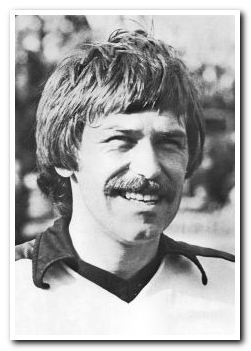
FRED BINNEY
Full Name: Frederick Edward Binney
Born: 12 August 1946
Came from: St Louis Stars, USA Went to: Hereford United
First game: 04 October 1977 Last game: 27 October 1979
Appearances: 81 (77/4) Goals: 42
Binney was born in Plymouth, but joined Argyle near the end of his career, rather than starting out at the club. A true Plymothian he was born in the Mutley area and raised on the Barbican, playing youth football for the Devonport Dockyard's CM (Construction & Maintenance) Department Juniors where he was noted by Argyle.
Argyle didn't follow-up and he duly joined South Western League side Launceston and played in the Devon Wednesday League for John Conway - the football team of the men's outfitter's shop in the city centre. Scoring for both frequently, professional football didn't seem a consideration, as he commenced an apprenticeship in the 'Yard as a shipwright. At the same time, he was also involved in the music scene in Plymouth with the The Hoe Nuts, who were a popular local group.
It was whilst playing for John Conway, that he was spotted by a Torquay United scout and invited to play for their reserves. Initially signing as an amateur, he signed his first professional contract in October 1966 and went on to score over 60 goals in three seasons with the Gulls' second string.
However, with Torquay legend Robin Stubbs scoring freely from Binney's preferred position, first team chances were at a premium. When called upon though, he was consistent, scoring 10 times in 24 appearances.
In February 1969 he was taken on loan, to Exeter City, by former Argyle legend Johnny Newman who was then in his debut managerial role at St James' Park. An initial 11 goals in 17 appearances helped steer City clear of the dreaded 're-election'. In March 1970 he joined permanently for a fee of £4,000. Initially curtailed by injuries, the 1971-72 season then saw a run of three consecutive seasons as City's top-scorer. In the 1972-73 season he actually finished joint top-scorer in the Football League with West Ham United's Bryan 'Pop' Robson, on 28 goals. He notched 25 goals in the following season and also won Exeter's Player of the Season award and the PFA (Professional Footballers' Association) Divisional Player of the Year for 1973-74. Whilst with City he also played up front with David Pleat, who he would later scout for, once retired, as Pleat's managerial career took off.
In four years at City he played 189 times and scored 98 goals - and with interest mounting from other clubs, he simply became too hot a property to retain. City turned down an offer from Swindon Town in November 1973 reported to be between £35-£40,000 but he eventually ended up signing for Brian Clough's Brighton & Hove Albion for a fee of £25,000 in May 1974. However Clough left for his ill-fated spell at Leeds United before Binney had even made his debut for the club. His first season was hit and miss with the changes at the club but it was in his second season he was most successful, scoring 23 league goals as Albion narrowly missed out on promotion to Division Two, under Clough's former assistant, Peter Taylor.
In three years on the Sussex coast he netted 35 goals in 70 appearances. Despite those stats, as Taylor left to re-join Clough at Nottingham Forest, Alan Mullery took over at the Goldstone and allowed Binney to leave, enabling him to take up an offer from America.
Binney moved to play for Missouri-based St Louis Stars in the burgeoning North American Soccer League (NASL) - the precursor to the modern day MLS (Major League Soccer) which was hitting its 1970's peak. Playing for the Stars for the 1977 season, he made 18 appearances and scored nine goals and also played in a memorable game against New York Cosmos. In May 1977, at the old Giants Stadium, in front of 20,112, he scored a powerful header to put Stars 1-0 up. At the end of the game, which ended 2-2, the NASL's signature "one-on-one" shoot-out followed, Binney scored the last goal to win the shoot-out 3-1, handing the Stars a 3-2 win (a shoot-out win added a goal to the full-time score, to give the game a winner). Cosmos featured Pelé and Franz Beckenbauer, yet Stars also won the return game in St Louis, to complete a memorable double over that season's NASL champions.
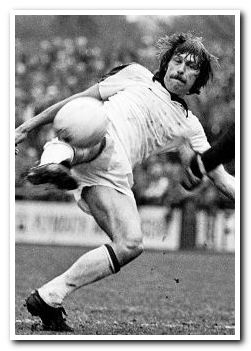
After his Stateside sojourn had finished, he finally did sign for his home town team, moving to Home Park on a free transfer in October 1977, joining a select club to have played in the Football League for all three Devon clubs. His first season in green, was a struggle, both for the team as it battled against being relegated for the second successive season, and for Binney who initially could not hold down his place. The following season saw a turn around in fortunes, 28 goals resulting in him topping the club's scoring charts and being voted the Player of the Season for 1978-79.
However, Binney did then suddenly fall from favour, not fitting in with new manager Bobby Saxton's plans. In January 1980, after 42 goals in 81 appearances - including a hat-trick away at Hillsborough against Sheffield Wednesday in September 1978 - all in barely more than two seasons, he was transferred to Hereford United for £37,000. Those goals endeared himself to the Home Park faithful, earning him 20th place in the forwards part of the Top 25 ‘Greatest Pilgrims’ vote, in July 2019. No mean feat at all when considering the longevity of stay of some of the others on the list compared to Binney's relatively short spell.
In two years at Edgar Street, Binney played 27 times and scored six goals. Whilst there, he subsequently qualified as a coach and was appointed assistant manager to his former Argyle team-mate, Frank Lord, who had taken the helm at the club. In 1982 Lord left for Malaysia and Binney soon followed, working as coach to the Malaysia national team before returning to Devon in 1985 as assistant manager to Colin Appleton at Exeter City. After Appleton was sacked in December 1987, Binney also left and took on the role of Recreation Officer at Plymouth University where he later became president and coach of the University of Plymouth football club.
In later years, Binney and his wife Lesley spent many years running a cream tea shop in Modbury, and enjoyed travelling the length and breadth of the country’s canals on their own narrowboat.
YOUR CONTRIBUTION
If you can add to this profile, perhaps with special memories, a favourite story or the results of your original research, please contribute here.
APPEARANCE DETAILS [reselect competitions]
The details below reflect appearances in all first-team competitions.
I'm very grateful to many who have helped write GoS-DB's player pen-pictures, and to Dave Rowntree, the PAFC Media Team and Colin Parsons for their help with photos. Thanks also to staff at the National Football Museum, the Scottish Football Museum and ScotlandsPeople for their valuable assistance.
The following publications have been particularly valuable in the research of pen-pictures: Plymouth Argyle, A Complete Record 1903-1989 (Brian Knight, ISBN 0-907969-40-2); Plymouth Argyle, 101 Golden Greats (Andy Riddle, ISBN 1-874287-47-3); Football League Players' Records 1888-1939 (Michael Joyce, ISBN 1-899468-67-6); Football League Players' Records 1946-1988 (Barry Hugman, ISBN 1-85443-020-3) and Plymouth Argyle Football Club Handbooks.
Greens on Screen is run as a service to fellow supporters, in all good faith, without commercial or private gain. We have no wish to abuse copyright regulations and apologise unreservedly if this occurs. If you own any of the material on this site, and object to its inclusion, please get in touch using the 'Contact Us' button at the top of the page.