 Contact Us
About GoS
Now in its 28th year, and
Contact Us
About GoS
Now in its 28th year, andstill amateur & advert-free Please do not copy GoS
material without asking
Can you help? This page is the result of the best endeavours of all concerned. If you spot a mistake or know of facts to add, or have a better photo, please get in touch using 'Contact Us' (top, right).
Back to GoS-DB Hub Find Another Player
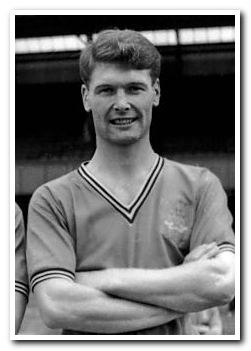
GEORGE KIRBY
Born: 20 December 1933
Came from: Sheffield Wednesday Went to: Southampton
First game: 16 January 1960 Last game: 15 September 1962
Appearances: 104 (104/0) Goals: 39
Born in Liverpool, Kirby was a powerful and brave centre-forward who, despite failing to make the grade at Everton, was destined to be a success at Home Park, and later becoming a remarkable journeyman through both his playing and coaching career. A gentleman off the pitch, he was often a demon on it and played with a hard edge that would not survive in today's modern game, and at times certainly 'led with his elbow' in aerial challenges leaving a trail of opposition players in heaps!
Signing his first professional contract at Goodison in June 1952, he waited three years for a debut but found chances limited and made just 26 appearances, scoring nine goals in seven years with the club. Leaving Merseyside he moved next to Sheffield Wednesday but again was frustrated by chances being limited, playing just three times without scoring in nine months at Hillsborough in the 1959-60 season.
With Argyle lacking goals and needing a foil for Wilf Carter, Kirby was bought to Home Park in the era of the joint-manager pairing of Neil Dougall and George Taylor. Kirby arrived in January 1960 along with Hillsborough team mate Jimmy McAnearney, in, aptly, a joint transfer.
Kirby was the perfect partner for the smaller Wilf Carter, who would use his pace around the box while Kirby used his physical presence to unsettle defenders. He made his Argyle debut against Middlesbrough at Home Park in January 1960, a match which also saw Johnny Newman's debut, as Argyle drew 2-2. Although he did not score in his first four games for the club, once he was up and running his confidence grew to the extent that he wasn't just a foil for Carter, but often a close match as they both vied to top the goalscoring chart. Kirby scored his first Football League hat-trick for Argyle against Portsmouth in September 1960, in a 5-1 home trouncing of the naval rivals.
The 1961-62 season saw Kirby continue to prosper with Carter as the pair netted 35 goals between them in Division Two and Argyle hit the heady heights of 5th place. Kirby was now much sought-after and in September 1962, then Argyle manager Ellis Stuttard accepted a bid from Southampton of £17,000. Kirkby had made over a century of appearances in green and scored 39 times in four seasons, with a strike rate not far shy of one-in-two.
Having scored his first Football League hat-trick for Argyle he did not have to wait long for his second, scoring it shortly after arriving in The Dell, in four minutes, no less! In two years with the Saints he played 63 times and scored 28 goals. He moved to Coventry City in 1964 for a brief spell playing 18 times and scoring 10 goals. He then had spells with Swansea Town (1964-1965) ahead of them becoming City in 1970, playing 26 times and scoring eight, followed by a spell with Walsall (1965-1967) playing 75 times, scoring 25 times for the Saddlers.
His next move was quite pioneering, becoming one of the first British players to move Stateside to the latest wave of 'soccer' there. He signed for the New York Generals for 1967 and 1968, based at the old Yankee Stadium. Playing the first season in the National Professional Soccer League (NPSL) in 1967 he played 18 times and scored 14 goals. In the second season, Generals were one of the founder members of North American Soccer League (NASL) in 1968. Kirby played 29 times and scored nine goals. Generals lasted just that single NASL season before folding. The 'Big Apple' had to wait another two years before the New York Cosmos took their place in 1970 (who, famously went on to attract Pele and Franz Beckenbauer). They also played at the old Yankee Stadium (initially) and kept the Generals' green and yellow colours.
Kirby then returned to the UK for one last hurrah, playing five times and scoring once for Brentford in the 1968-1969 season, before winding down in non-league with Worcester City.
After retiring as a player, he moved into management. Initially starting out at Halifax Town as coach to Alan Ball Senior (the father of the 1966 World Cup Winner) he took the reins as first team manager in 1970, once Ball departed. Kirkby spent only one full season in charge, but led the club to their most successful campaign, just missing out on promotion to the old Second Division. He then started the 1971-72 season by leading Halifax to a 2-1 Watney Cup pre-season victory over a full-strength Manchester United side, which included George Best, Denis Law and Bobby Charlton, in front of the watching BBC cameras.
However, just a week later, he left Halifax to take charge at Watford, where he remained until May 1973, a tenure blighted by injuries, boardroom unrest, and a shortage of luck and money.
He the moved to become manager of one of Iceland's leading sides Íþróttabandalag Akraness known as ÍA, between 1974 and 1978 (punctuated by a brief spell coaching in Kuwait), leading the club to two championships and two cup finals as well as European football. The club's players also dominated selection to the Iceland national team.
In 1978, he left Akranes and returned to Halifax, this time inspiring the team to another famous victory over Mancunian rivals; second time around it was the turn of former Argyle manager, Malcolm Allison's Manchester City, who fell to a single goal in an FA Cup 3rd round tie in January 1980. His second spell at The Shay, during which he also become a paid director and Chief Executive, ended in June 1981 after a string of poor results saw the team finish second bottom of the old Fourth Division. However during his two spells with the club he masterminded quite probably their two greatest results in their history.
He then returned for three more spells with ÍA in 1980, 1982 and 1990 intermixed with spells coaching in Indonesia and Saudi Arabia. He then spent a spell scouting for Queens Park Rangers in the late 1990s, having also scouted for West Brom and Everton previously.
Having settled in Elland in West Yorkshire during his time with Halifax, his health deteriorated and he sadly lost a battle with cancer. He passed away in Elland in March 2000 aged 66, after a remarkable career on and off the pitch.
YOUR CONTRIBUTION
If you can add to this profile, perhaps with special memories, a favourite story or the results of your original research, please contribute here.
APPEARANCE DETAILS [reselect competitions]
The details below reflect appearances in all first-team competitions.
I'm very grateful to many who have helped write GoS-DB's player pen-pictures, and to Dave Rowntree, the PAFC Media Team and Colin Parsons for their help with photos. Thanks also to staff at the National Football Museum, the Scottish Football Museum and ScotlandsPeople for their valuable assistance.
The following publications have been particularly valuable in the research of pen-pictures: Plymouth Argyle, A Complete Record 1903-1989 (Brian Knight, ISBN 0-907969-40-2); Plymouth Argyle, 101 Golden Greats (Andy Riddle, ISBN 1-874287-47-3); Football League Players' Records 1888-1939 (Michael Joyce, ISBN 1-899468-67-6); Football League Players' Records 1946-1988 (Barry Hugman, ISBN 1-85443-020-3) and Plymouth Argyle Football Club Handbooks.
Greens on Screen is run as a service to fellow supporters, in all good faith, without commercial or private gain. We have no wish to abuse copyright regulations and apologise unreservedly if this occurs. If you own any of the material on this site, and object to its inclusion, please get in touch using the 'Contact Us' button at the top of the page.