
 Contact Us
About GoS
Now in its 28th year, and
Contact Us
About GoS
Now in its 28th year, andstill amateur & advert-free Please do not copy GoS
material without asking

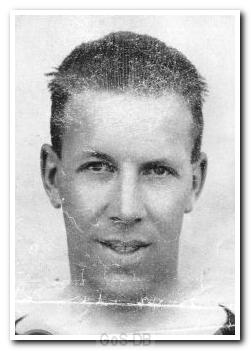
Can you help? This page is the result of the best endeavours of all concerned. If you spot a mistake or know of facts to add, or have a better photo, please get in touch using 'Contact Us' (top, right).
Back to GoS-DB Hub Find Another Player
JOHNNY MCNEIL
1. Came from: Inverness Caledonian Went to: Clapton Orient
1. First game: 20 October 1934 Last game: 11 February 1939
2. Came from: Clapton Orient Went to: Clapton Orient
2. First game: 13 January 1940 Last game: 13 January 1940
Appearances: 145 (145/0) Goals: 13
Contemporary football references consistently describe him as J. L. McNeil or John Law McNeil, and give his birthplace as Inverkeithing, often citing 1906 as his year of birth. However, no birth could initially be found under the surname McNeil or in Inverkeithing.
Examination of the statutory records established that he was born John Law in Jamestown, Inverkeithing, on 1st September 1906. He was the son of John Law and Helen Addison, who had married in Maryhill in 1896. Helen later married Peter McNeil, after which her son John adopted the surname McNeil, under which he became known throughout his football career. Law was therefore his birth surname rather than an official middle name, although it is often recorded as such. The date 25th September 1906 also appears in some football reference works, but this was the date his birth was registered rather than the date on which he was born.
Following his birth in Inverkeithing, McNeil developed into an often free-scoring centre-half and began his career with Bo'ness, who were then briefly members of the Scottish Football League, before moving to Musselburgh Bruntonians, who later became Musselburgh Athletic. He was given a chance with Heart of Midlothian in 1925, with his time at Tynecastle also including a loan spell with Raith Rovers, for whom he made 18 appearances and scored one goal in 1927. However, he struggled to establish himself and, having made 29 appearances and scored 18 times, moved to then top-flight Portsmouth in 1928, where he played 14 times and scored eight goals. A year later he signed for Reading, making 47 appearances and scoring five goals during a five-season stay.
Whilst at Elm Park, records suggest that he had trial spells with Airdrieonians and Shelbourne during the close season in 1930. Having left Reading at the end of the 1931-32 season, he moved to ambitious Southern League side Guildford City. He returned to Scotland and was registered with Heart of Midlothian again in 1933 and, later the same year, with Inverness-based side Caledonian, who would later merge with Inverness Thistle to form the modern-day Inverness Caledonian Thistle. In the summer of 1934 he then made the long move to the South West to sign for Argyle under Bob Jack.
Taking over from David Hill, McNeil made nearly 150 appearances at centre-half during a six-season stay, scoring 13 goals, before being displaced by the arrival of Jimmy Clark. In 1939 he moved to Clapton Orient on a free transfer, making three League appearances before the outbreak of the Second World War led to the abandonment of the 1939-40 Football League season.
He returned briefly to Argyle in January 1940, making one further appearance as a guest in the South West Regional League, possibly suggesting a local wartime posting. During the Second World War he served in the Royal Air Force as a Physical Training Instructor (PTI).
After his playing career ended, he managed Southern League Merthyr Tydfil from 1946 until June 1947, when he was appointed manager of Torquay United. After a disappointing first season, subsequent campaigns saw finishes of ninth and fifth, but after complaining about low attendances at Plainmoor during a period of comparative success, he resigned to take the manager's post at Bury in March 1950. He was subsequently presented with an electric clock when he left the Gulls.
His time at Bury was more fraught than in South Devon, as he faced a regular battle against relegation, although he managed to keep the club clear of it. He eventually resigned in November 1953, which proved to be his last recorded involvement in professional football.
In 1954 he became landlord of the King's Head in Chacewater, a village between Truro and Redruth in Cornwall. He ran the pub successfully for several years before continuing a wider involvement in the hotel and hospitality business in the West Cornwall area.
Eventually returning to Scotland, he passed away in Crieff in March 1971, aged 64. He was listed as an agricultural merchant at the time of his death, with his death certificate confirming his identity as "John McNeil (formerly Law)".
YOUR CONTRIBUTION
If you can add to this profile, perhaps with special memories, a favourite story or the results of your original research, please contribute here.
APPEARANCE DETAILS [reselect competitions]
The details below reflect appearances in all first-team competitions.
We are very grateful to many who have helped write GoS-DB's player pen-pictures, and to Dave Rowntree and the PAFC Media Team for their help with photos. Thanks also to staff at the National Football Museum, the Scottish Football Museum and ScotlandsPeople for their valuable assistance.
The following publications have been particularly valuable in the research of pen-pictures: Plymouth Argyle, A Complete Record 1903-1989 (Brian Knight, ISBN 0-907969-40-2); Plymouth Argyle, 101 Golden Greats (Andy Riddle, ISBN 1-874287-47-3); Football League Players' Records 1888-1939 (Michael Joyce, ISBN 1-899468-67-6); Football League Players' Records 1946-1988 (Barry Hugman, ISBN 1-85443-020-3) and Plymouth Argyle Football Club Handbooks.
Greens on Screen is run as a service to fellow supporters, in all good faith, without commercial or private gain. We have no wish to abuse copyright regulations and apologise unreservedly if this occurs. If you own any of the material on this site, and object to its inclusion, please get in touch using the 'Contact Us' button at the top of the page.