 Contact Us
About GoS
Now in its 28th year, and
Contact Us
About GoS
Now in its 28th year, andstill amateur & advert-free Please do not copy GoS
material without asking

Can you help? This page is the result of the best endeavours of all concerned. If you spot a mistake or know of facts to add, or have a better photo, please get in touch using 'Contact Us' (top, right).
Back to GoS-DB Hub Find Another Player
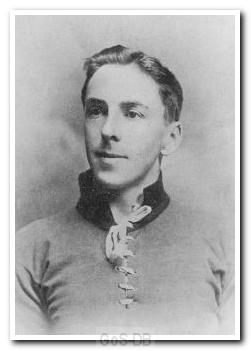
HARRY RAYMOND
Note: One record book says that Hindmarsh scored the second goal against Southend on 30 Apr 1910, another says it was a second for Raymond. The match report in the Western Morning News and other papers clearly describes the goal scored by Raymond. The overall goal totals for these players are therefore different from at least one other source.
1. Came from: Woodland Villa Went to: Career interrupted by WW1
1. First game: 21 September 1908 Last game: 24 April 1915
2. Came from: Career interrupted by WW1 Went to: Torquay United
2. First game: 30 August 1919 Last game: 29 December 1923
Appearances: 260 (260/0) Goals: 51
Raymond was a local boy made good. Born in the Crownhill area of Plymouth, he played as a youth for Crownhill Juniors, Crownhill Reserves and then Woodland Stars. He was later captain of Mutley Grammar School and started working as a horse saddle and harness maker. In 1905 he signed for Crownhill FC before a spell with Woodland Villa, from whom he joined Argyle in 1908 in a period when the club was 'managed by committee'.
Raymond retained his amateur status well into his Argyle career but gradually forced his way into the first team and became one of the club's most consistent performers over the next seven years, playing at both inside-forward positions.
An Argyle season handbook of the time, described Raymond as "one of the most brilliant forwards this district has produced" and "a perfect artist with the ball, but most unselfish". His talent soon attracted wider attention: he was selected as one of 15 non-travelling reserves for the Team GB side at the 1912 Stockholm Olympics, and earned three amateur caps for England between 1913 and 1914. He was also chosen for the Southern League XI representative side and was part of the Argyle side which won the Southern League title in 1912-13.
World War I interrupted his career, during which he played for Motherwell as a guest, he also served as Private with the Royal Army Medical Corps (RAMC) Service during the conflict, and returned to Argyle after the cessation of hostilities.
Raymond played five more seasons for the club, playing under Bob Jack and assisting in the transition to the Football League. In total he had spent 12 seasons at Home Park, seven before the war and five after it, making 260 appearances and scoring 51 goals. The last four of his twelve seasons saw him playing in the Football League, his last 67 appearances and 10 goals for the club, were at that level. During this time, Argyle finished runners-up in the Third Division (South) on three successive occasions, at a time when only the champions were promoted.
He then left Home Park after 16 years to finish his career with a stint as player-manager of Torquay United, but not before a Benefit Match was arranged for him.
Argyle played the famous amateur side Corinthians on 7th April 1924, in a nod to Raymond's long-standing commitment to being an amateur for large parts of his career, particularly whilst in the Southern League. Argyle won the match 2-1 with the gate described as "some 5,000 delighted onlookers".
At Plainmoor, he served as just the second manager in the history of the current Torquay United, that being from 1920 when they adopted 'United' having been Torquay Town, and ahead of the election to the Football League in 1927. He held the role of player-manager during the first half of the 1924-25 season in the Southern League, with his tenure lasting from July to December 1924, and spanning 16 games with a win rate of 31.25%. Although his win-rate was significantly lower than his predecessor, their first-ever manager, Crad Evans at 51.92%, the appointment of Raymond, given his pedigree, was seen as a major coup for the club.
Following his departure from Torquay in December 1924, he returned to Plymouth. By the 1930s, despite his status as a club legend, he faced the risk of unemployment during the Great Depression but Argyle continued to provide him with steady work, having offered him a position on the club's ground staff.
By 1939, records show he had moved into industry, working as an Engineer’s Fitter. It is widely believed he returned to the Devonport Dockyard, where he had previously worked during his early playing days and during World War I. He was living in the Plympton area of Plymouth with his family in the late 1930s.
He remained living locally for the rest of his life and passed away, in Plymouth, in September 1955 at the age of 68 years old.
YOUR CONTRIBUTION
If you can add to this profile, perhaps with special memories, a favourite story or the results of your original research, please contribute here.
APPEARANCE DETAILS [reselect competitions]
The details below reflect appearances in all first-team competitions.
I'm very grateful to many who have helped write GoS-DB's player pen-pictures, and to Dave Rowntree, the PAFC Media Team and Colin Parsons for their help with photos. Thanks also to staff at the National Football Museum, the Scottish Football Museum and ScotlandsPeople for their valuable assistance.
The following publications have been particularly valuable in the research of pen-pictures: Plymouth Argyle, A Complete Record 1903-1989 (Brian Knight, ISBN 0-907969-40-2); Plymouth Argyle, 101 Golden Greats (Andy Riddle, ISBN 1-874287-47-3); Football League Players' Records 1888-1939 (Michael Joyce, ISBN 1-899468-67-6); Football League Players' Records 1946-1988 (Barry Hugman, ISBN 1-85443-020-3) and Plymouth Argyle Football Club Handbooks.
Greens on Screen is run as a service to fellow supporters, in all good faith, without commercial or private gain. We have no wish to abuse copyright regulations and apologise unreservedly if this occurs. If you own any of the material on this site, and object to its inclusion, please get in touch using the 'Contact Us' button at the top of the page.