 Contact Us
About GoS
Now in its 28th year, and
Contact Us
About GoS
Now in its 28th year, andstill amateur & advert-free Please do not copy GoS
material without asking
Can you help? This page is the result of the best endeavours of all concerned. If you spot a mistake or know of facts to add, or have a better photo, please get in touch using 'Contact Us' (top, right).
Back to GoS-DB Hub Find Another Player
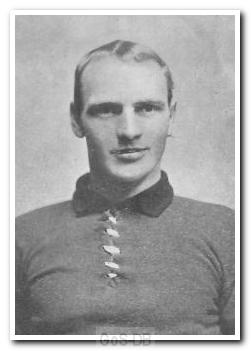
JACK BUTLER
Full Name: John Butler
Born: 27 May 1877
Came from: Grimsby Town Went to: Released
First game: 02 September 1907 Last game: 01 May 1915
Appearances: 297 (297/0) Goals: 2
Butler was born in Kiveton Park, near Sheffield, which was also the birthplace of legendary manager Herbert Chapman and Notts County star & future England international Bert Morley.
Butler was a full back and most records suggest he was born in 1885 in or near Kiveton; however, subsequent research shows he was actually born earlier, in West Bromwich in 1877 and grew up in Kiveton after his family had moved to the area looking for work at the local colliery.
He started playing football for Kiveton Park as a teenager, and in 1897, he got on the wrong side of the law for actions taken on the pitch. During a game against Holbrook Works, a Holbrook player complained to the referee about the rough play of Kiveton. Jack was reported to have laughed in the players' face, stated 'You're not at school now, boy', punched him square in the face and instructed his team-mates 'Come on lads, let's kick their ****ing heads off'. He argued he had no recollection of such incidents, but was fined 20 shillings and suspended for the rest of the season.
It was perhaps for the best that Jack then joined the Army and spent the next 7-8 years away from home. He joined the Royal Artillery and was a regular for the Army football team for two seasons. On his return to the village, Jack resumed playing football for the village club and, at the age of 28, made a surprise and late entry into the professional game. Signing for Grimsby Town in 1904, he took no time fitting in, scoring twice on his Football League debut against Bristol City in March 1905 and playing alongside fellow Kivetoners, the aforementioned Bert Morley and William Ross. Initially used as a forward, before a change of position to full-back, he spent three years at Grimsby, where he made 47 appearances and scored three goals in total.
In 1907, he made the long move to Home Park, to then Southern League Argyle, where he became the first-choice right-back for almost eight years and an extremely reliable performer. Aged 30 when he signed, Jack nevertheless went on to play almost 300 games across both the Southern and Western League campaigns of the time. He had transitioned into a fearsome defender as a professional, and very few forwards dared cross his path. He scored twice in his time at Home Park, once in 1909 in a 6-0 Southern League home win over Coventry City in November 1909, and the second was in an 4-1 FA Cup 1st Round home win over Lincoln City in January 1914.
On Boxing Day 1910, Butler was involved in a peculiar moment in Argyle's history: an outfielder was forced to wear the goalkeeper's jersey for the whole game, the only such circumstance in the club's history and one that is unlikely to occur again. Horne was taken ill in London ahead of the match at West Ham, and with Sutcliffe not with the travelling party because he was also unwell in Plymouth, right-back Butler played the entire match between the posts. The 4-0 defeat was an inevitable result for the depleted side, which also saw Argyle play with only ten men in the first half, before trainer Tommy Haynes turned out for the second period.
The 1911 Census showed John (Jack) Butler as living with fellow Argyle player Septimus Atterbury in the city. The following year, he was part of the Argyle side which won the Southern League title in 1912-13. The 1913-14 Argyle handbook described Butler as "an evergreen, who retains most of his original speed, while as a genuine whole-hearted trier he is unequalled".
The First World War did then however, effectively bring Butler's career to an end, although he did return to Home Park after the conflict, but without making any further first team appearances.
His Army days had clearly instilled a sense of personal fitness in Jack, as he last played for Argyle aged 37, and even after the First World War, he turned out for Kiveton Park once again, well into his 40s. His playing days came to an end in 1920 when the authorities, fed up with his constant bad behaviour, suspended him for eight months for using bad language towards an official. It was a sign to hang up the boots.
Jack then worked back at Dinnington Colliery for the remainder of his working life and died locally in 1958 aged 82.
YOUR CONTRIBUTION
If you can add to this profile, perhaps with special memories, a favourite story or the results of your original research, please contribute here.
APPEARANCE DETAILS [reselect competitions]
The details below reflect appearances in all first-team competitions.
I'm very grateful to many who have helped write GoS-DB's player pen-pictures, and to Dave Rowntree, the PAFC Media Team and Colin Parsons for their help with photos. Thanks also to staff at the National Football Museum, the Scottish Football Museum and ScotlandsPeople for their valuable assistance.
The following publications have been particularly valuable in the research of pen-pictures: Plymouth Argyle, A Complete Record 1903-1989 (Brian Knight, ISBN 0-907969-40-2); Plymouth Argyle, 101 Golden Greats (Andy Riddle, ISBN 1-874287-47-3); Football League Players' Records 1888-1939 (Michael Joyce, ISBN 1-899468-67-6); Football League Players' Records 1946-1988 (Barry Hugman, ISBN 1-85443-020-3) and Plymouth Argyle Football Club Handbooks.
Greens on Screen is run as a service to fellow supporters, in all good faith, without commercial or private gain. We have no wish to abuse copyright regulations and apologise unreservedly if this occurs. If you own any of the material on this site, and object to its inclusion, please get in touch using the 'Contact Us' button at the top of the page.